Can Dogs Eat Strawberries? A Neurologist's Honest Take on the Trend
Medically reviewed by Roger Clemmons, DVM, PhD, DACVIM (Neurology and Neurosurgery), CVA, CVFT — For general education — not a substitute for veterinary care.
Yes, dogs can eat strawberries in small, prepped portions, though the safe amount depends on size and health.
On this page
The trend everyone’s suddenly asking about
Someone’s dog is always mid-strawberry on your feed this week — nose buried in a bowl, tail going, owner narrating like it’s breaking news. The sound gets remixed, the comments fill with “wait, is this actually safe,” and by Thursday half the group chat has bought a carton for the dog instead of the smoothie. That’s the pattern with produce trends: the enthusiasm arrives faster than the label-reading does.
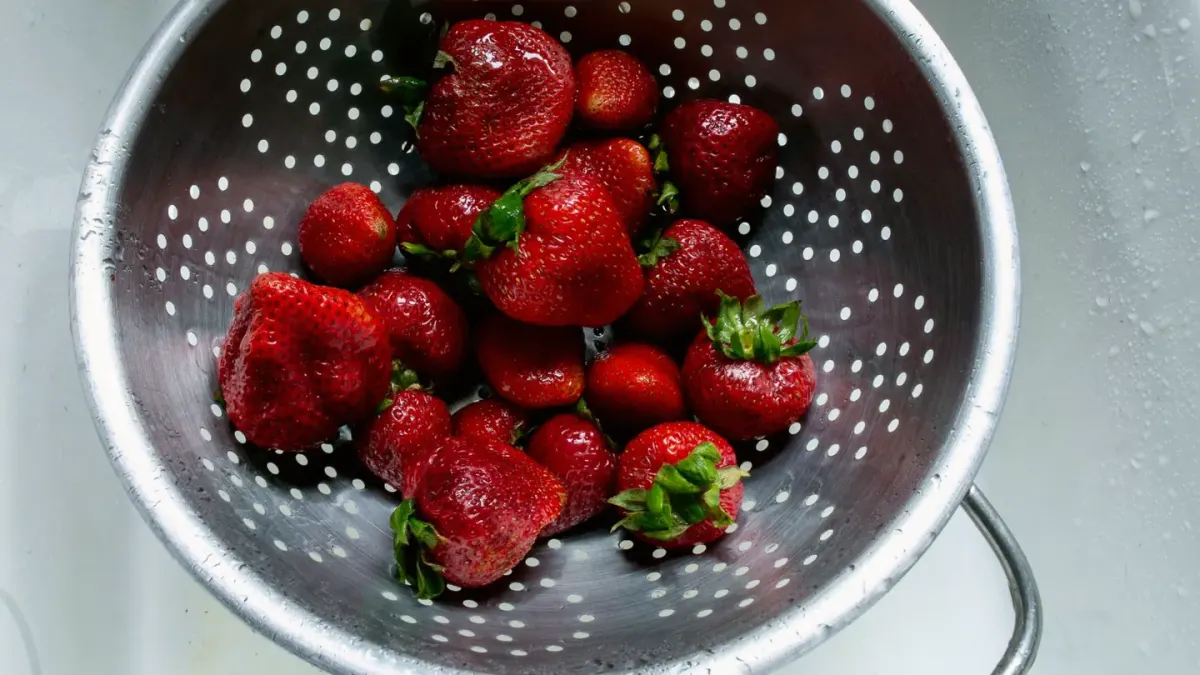
Here’s the short version, and then the honest one. Strawberries are not toxic to dogs. The American Kennel Club puts one to three strawberries a day as a reasonable starting point for most dogs, scaled to size, and the ASPCA lists the genus Fragaria as non-toxic to dogs outright. That’s the easy part. The part worth slowing down for is everything after “yes.”
Picture a fifty-pound mixed breed named Otis, parked at his owner’s feet during weekend meal prep, doing the low-effort stare that gets results. She tosses him half a strawberry, he inhales it whole — stem still attached because nobody hulled it fast enough — and for a second she wonders if that was fine or if she just made a mistake she’ll be Googling in the car. It’s a small moment, but it’s the exact moment this whole trend actually lives in: not “can dogs eat strawberries,” but “did I just hand my dog the wrong version of a safe food.”
How many strawberries is actually safe
Size does most of the work here. As a rough guide, small dogs under about 20 pounds do best with no more than one or two strawberries a day, medium dogs in the 21-50 pound range can typically handle three to five, and large dogs over 51 pounds can go up to five or six as an occasional treat rather than a daily habit. None of that is a hard ceiling — it’s a starting point, and the same standard treat math still applies underneath it: treats, strawberries included, should stay under roughly 10% of a dog’s total daily calories. Frozen, unsweetened slices are fine. Canned strawberries, jam, or anything packed in syrup are not — the fruit isn’t the problem there, the added sugar is.

The sugar question nobody’s prepping for
Toxicity was never really the risk with strawberries. Sugar is. A ripe strawberry carries a modest amount of natural sugar, low enough that most healthy dogs handle it without issue, but not zero — and for a dog managing diabetes, obesity, or a history of pancreatitis, that number stops being trivial. This is where I’d rather a reader over-ask their vet than under-ask them. If your dog is on an insulin protocol, a food swap that seems harmless on TikTok can still move a glucose curve you and your vet worked hard to calibrate. Small, infrequent, and cleared with your vet is the version I’d actually sign off on for that dog. For a lean, otherwise healthy adult dog, the math is a lot more forgiving.
Hulls, stems, and the choking risk everyone forgets
The green cap and stem aren’t toxic, but they’re fibrous, a little sharp-edged, and exactly the kind of thing a fast eater swallows without chewing. Cut strawberries into small pieces and remove the hull before you offer any, especially for small breeds, brachycephalic dogs, or any dog with a track record of gulping first and thinking later. This is a two-second prep step that eliminates most of the actual risk in this whole conversation — more risk, honestly, than the fruit itself ever carried.
When a sensitive gut changes the math
Here’s where I want to slow down, because this is the piece that gets skipped in a fifteen-second video. Fiber-forward treats interact differently with a compromised gut than with a healthy one. In dogs being managed for exocrine pancreatic insufficiency, treatment already centers on pancreatic enzyme replacement, a lower-residue diet, and cobalamin support, according to a review in the Journal of the American Veterinary Medical Association — and that same review notes researchers still don’t fully understand why dysbiosis persists in some of these dogs even after enzyme therapy starts. Layering a new fiber source on top of that picture isn’t dangerous, but it isn’t neutral either, and it’s a conversation for your vet, not a comment section.
Think of a dog mid-recovery from a rough GI stretch, finally eating consistently again, owner hesitant to introduce anything new for fear of undoing the progress. That hesitation is reasonable. A study in Frontiers in Veterinary Science on probiotic response in dogs found that diversity metrics alone didn’t distinguish which dogs responded to supplementation and which didn’t — in plain terms, two dogs can look similar on paper and still react to the exact same food differently. That’s precisely the situation where I’d rather reach for both the imaging or lab workup and the slower, individualized plan than hand out a blanket yes. It’s the same instinct that has me reaching for both the diagnostic tool and the acupuncture needle in clinic: use whatever the evidence actually supports for that specific dog, and stop there.
If your dog’s stomach is already a known variable — recent GI upset, a diagnosed condition, or a track record of not tolerating produce well — a conversation with your vet before adding strawberries is worth more than the trend is. Related reading on that front: our pieces on switching foods without upsetting a senior dog’s gut, on how much fiber is actually too much, and on how to evaluate a probiotic if you’re already leaning that direction all sit downstream of this same question. So does our look at sweet potato, another produce trend that gets more nuanced the longer you look at it.
The verdict
Strawberries earn their spot on the safe-treat list. They’re not the villain some viral “foods to never feed your dog” list makes them out to be, and they’re not the miracle superfood the other half of the algorithm claims either. For a healthy adult dog, a few hulled, sliced strawberries a few times a week is a defensible treat, not a risk. For a dog with diabetes, a GI condition, or a fiber sensitivity, the same fruit needs a smaller portion and a vet in the loop before it becomes a habit. The trend isn’t wrong. It’s just missing the size of the print at the bottom, and that print is where the real answer for your specific dog is written.
Frequently asked questions
Are strawberry stems and leaves dangerous for dogs?
Not toxic, but they're fibrous and can be a choking hazard or cause mild stomach upset. Hull them before serving, especially for small dogs or fast eaters.
Can diabetic dogs eat strawberries?
Only in very small, infrequent amounts, and only with your vet's input, since strawberries still carry natural sugar that affects blood glucose.
How many strawberries can a dog eat in one sitting?
As a rough starting point, one to three strawberries a day depending on the dog's size, kept under about 10% of daily calorie intake.
Sources
- Can Dogs Eat Strawberries? — American Kennel Club (AKC)
- Strawberry (Fragaria spp.) — Toxic and Non-Toxic Plants — ASPCA
- Review: Exocrine Pancreatic Insufficiency Management in Dogs and Cats — Journal of the American Veterinary Medical Association (JAVMA)
- Probiotic Response and Gut Microbiome Diversity in Dogs — Frontiers in Veterinary Science