Low-Calorie Treats for an Overweight Dog: The Math Behind the Bag
Medically reviewed by Justin Shmalberg, DVM, CVA, ACVN, ACVSMR — For general education — not a substitute for veterinary care.
If a treat doesn't fit inside the 10% daily-calorie rule, its label doesn't matter — do the math before the bag goes in the cart.

On this page
Here’s the fork every owner of a heavy dog eventually hits: keep dishing out the same treats in smaller amounts, or switch to something built around a lower calorie density in the first place. Both sound reasonable. Only one actually moves the needle on a dog that’s carrying 15% or more over ideal body weight.
The 10% rule and why it gets ignored
Veterinary nutrition guidance generally caps treats — all of them, combined — at roughly 10% of a dog’s total daily calories, with the rest coming from a complete and balanced diet formulated to manage the remainder. That’s not an arbitrary number; it’s the point past which supplemental snacks start displacing the nutrient balance the base diet was built to deliver. The problem is that most commercial treats aren’t labeled with calories per piece, only per bag, so an owner doing the math has to work backward from a guaranteed-analysis panel that wasn’t designed for that purpose. A single greenie-style dental chew or a peanut-butter biscuit can run 40–90 kcal, which sounds trivial until you’re handing three or four out over a day to a 20-pound dog whose entire caloric budget might be 500–600 kcal.
What actually drops the calorie count
Three levers do most of the work: swapping fat for fiber, choosing whole vegetables over rendered meat meals, and shrinking portion size to something that still functions as a reward. Fat carries more than double the calories per gram of protein or carbohydrate, so a treat built around a lean protein or a vegetable base beats one leaning on animal fat or oil for palatability. Pumpkin is the ingredient that shows up constantly in this conversation, and for good reason — pumpkin fiber is a gentle, natural source of both soluble and insoluble fiber, according to a Boops Pets vet-reviewed claim list, which makes it useful as bulk that doesn’t add much energy density. Freeze-dried single-ingredient proteins (plain chicken breast, whitefish) run lean for the same reason: almost no added fat, no filler starches, and a piece size an owner can break into slivers.
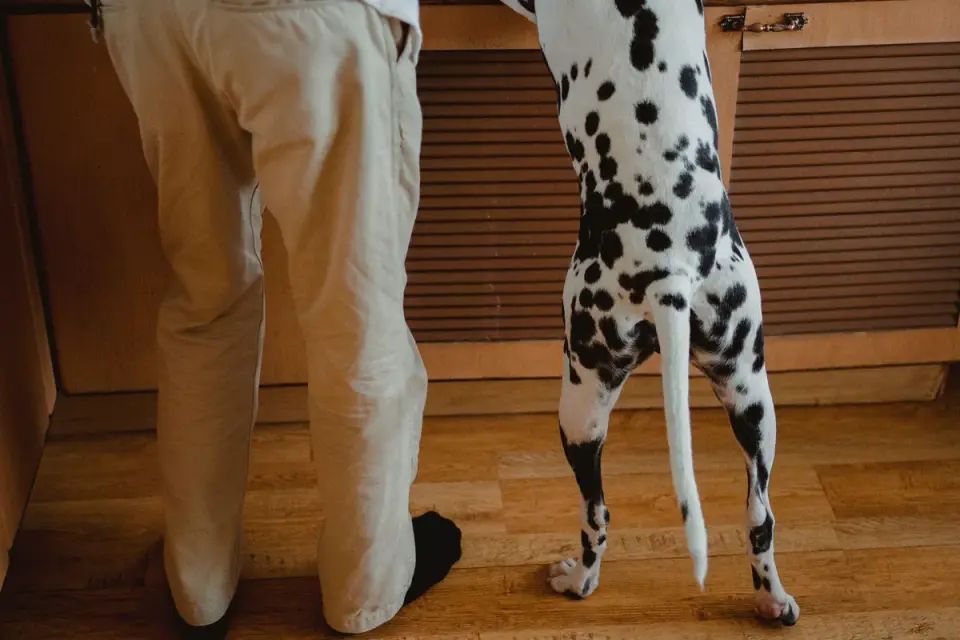
I think about a 9-year-old Labrador retriever, 78 pounds against a target weight closer to 65, whose owner had been using training treats through every walk because the dog was “food motivated” and it kept him calm around other dogs. Three weeks into simply swapping those biscuits for quarter-inch cubes of plain steamed chicken breast, the owner reported he’d dropped just under two pounds — not dramatic, but the direction that matters, and achieved without changing a single walk or a single training session. The treat itself hadn’t been the whole problem. The volume had.
Where low-fat and low-calorie stop meaning the same thing
This is where a lot of “diet treat” marketing gets sloppy. A treat can be low in fat and still be dense in calories if it’s loaded with simple carbohydrates or glycerin as a binder — sugar alcohols and syrups carry calories too, they just don’t trip the “fat” claim on a label. For dogs managing pancreatitis risk or other fat-sensitive conditions, our guide on low-fat feeding for dogs prone to pancreatitis goes deeper into why the label percentage alone doesn’t tell the whole story. The overlap with weight management is real but not total — a dog can need both a lower-fat diet and a lower-calorie one, or just one of the two, and conflating them leads owners to buy the wrong bag.
Fresh produce is the other lever, and it’s the one I lean on hardest with clients managing an overweight dog, because it lets you increase the number of treats given without increasing the calorie load nearly as much. Thin apple slices (seeds and core removed — our piece on what part of the apple actually worries a vet covers that tradeoff) or half-inch banana coins both run under 5 kcal per piece, which is a different category entirely from a manufactured biscuit. Our guide to feeding bananas to dogs covers portion limits, since banana’s natural sugar content means “low calorie” doesn’t mean “unlimited.”
Where this gets complicated: not every low-calorie swap is metabolically neutral. I saw a case that reframed how I talk about this — a 6-year-old terrier mix, roughly 22 pounds, whose owner had shifted almost entirely to raw baby carrots as treats after reading that vegetables were the safe default. By day 10, the dog had developed loose, more frequent stool, not from toxicity but from a sudden jump in fermentable fiber the gut hadn’t adjusted to. The fix wasn’t abandoning vegetables — it was reintroducing them at a fraction of the volume and building up over two weeks. Low calorie doesn’t mean low consequence if the transition is abrupt.
Reading a treat label like a nutritionist would
Look past the front-of-bag claims and check three things: calories per treat (call the manufacturer if it’s not listed), the position of fat and sugar sources in the ingredient list, and the serving guidance relative to the dog’s actual weight, not a size range. A treat marketed for “small dogs” that runs 25 kcal a piece is not automatically appropriate for every dog under 20 pounds — a 10-pound dog and an 18-pound dog have meaningfully different daily budgets. Digestive tolerance matters here too: research on probiotic supplementation in dogs found that diversity metrics did not distinguish non-responders from responders, a reminder that gut-support additions marketed alongside diet treats don’t affect every dog predictably, according to a study published in Frontiers in Veterinary Science. That’s a case for introducing any new treat, low-calorie or not, gradually and watching the individual dog rather than assuming a universal response.
For dogs with diagnosed digestive disease layered on top of weight concerns — exocrine pancreatic insufficiency being the clearest example — treat selection becomes secondary to the underlying nutritional management. EPI is treated by pancreatic enzyme replacement therapy, nutritional management with low-residue diets of moderate fat content, and supplementation of cobalamin, according to a review published in the Journal of the American Veterinary Medical Association. A treat strategy has to sit inside that plan, not override it, and that conversation belongs with the prescribing veterinarian rather than a bag label.
The verdict
A low-calorie treat is really just a treat with a favorable ratio of reward to energy cost, and the ingredients that deliver that — lean single-source proteins, pumpkin, thin-cut fruit and vegetable pieces — aren’t glamorous or trending on anyone’s feed. They’re just arithmetic. Stay inside the 10% rule, favor fiber and lean protein over fat and syrup, introduce anything new slowly enough to watch how the individual dog’s gut responds, and loop in a veterinarian when there’s an underlying digestive condition complicating the picture. That’s the whole strategy — no bag required to make it work.
Frequently asked questions
How many calories should treats make up in a dog's day?
A commonly used veterinary guideline caps all treats combined at roughly 10% of a dog's total daily calorie intake, with the remainder coming from a complete and balanced diet.
Are vegetables always a safe low-calorie treat swap?
Usually, but introduce them gradually. A sudden jump in fermentable fiber, such as switching abruptly to large amounts of raw carrots, can cause loose stool even though the ingredient itself isn't dangerous.
Does low-fat mean low-calorie?
Not necessarily. A treat can be low in fat and still calorie-dense if it relies on sugars, glycerin, or other carbohydrate-heavy binders.
Sources
- EPI treatment and nutritional management review — Journal of the American Veterinary Medical Association
- Probiotic supplementation and digestive health in dogs — Frontiers in Veterinary Science