What to Teach Your Puppy First: The First Five Cues
Most owners try to load a new puppy with ten commands in week one; the ones who end up with a genuinely well-mannered adult dog usually teach five, in a specific order, over roughly six weeks.

On this page
Quick checklist — the first five cues, in order:
- Name recognition — the puppy turns toward you on sound alone, no treat visible yet
- Sit — the default “wait a beat” position before doors, food bowls, and greetings
- Come — recall on a long line, built in a boring backyard before it’s tested anywhere exciting
- Leave it — impulse control around dropped food, other dogs, and sidewalk trash
- A loose-leash start — not a formal heel, just “walking near me doesn’t hurt”
The AVSAB’s Position Statement On Puppy Socialization puts the primary socialization window at roughly the first three months of a puppy’s life — the stretch when sociability still outweighs fear and new experiences are absorbed fastest. That window is also when these five cues get built, so the order matters as much as the cues themselves.
The fork: cues versus socialization, and why it’s a false choice
Here’s the decision fork most new owners hit around week two: do I drill commands, or do I spend the puppy’s limited socialization window on exposure — car rides, new floors, new faces? Owners often treat it as an either/or. It isn’t. The AVSAB statement is explicit that training and socialization should run together, with classes and at-home sessions built on positive reinforcement — frequent rewards, praise, play, and treats — rather than correction-based methods. A five-minute sit rep in a new parking lot does both jobs at once.
Name recognition and sit: the on-ramp
Name recognition comes first because nothing else works without it. A puppy that doesn’t reliably turn toward a sound can’t be redirected, recalled, or praised at the right moment — the cue has to land before the behavior can be shaped. The American Kennel Club’s guide to 5 Simple Cues You Should Teach Your Puppy lists name recognition first for exactly this reason, followed by sit, which it describes as usually the easiest command to build and a fast confidence win for both ends of the leash.
Sit earns its place second because it’s a default. It isn’t a trick; it’s a parking brake you can ask for before a door opens, before a bowl goes down, before a greeting gets too big. I ask new owners to think of it less as a command and more as a habit they’re installing — a place the puppy’s body goes automatically when it isn’t sure what else to do.
In my practice, I had a client bring in a ten-week-old Cavalier puppy, about six pounds, who’d learned to sit for treats but hadn’t learned her own name yet — she’d respond to a kissy noise, not to being called. The owner had jumped straight to tricks because they were fun and skipped the boring foundational step. We reset for two weeks: name, then a treat, every single time, no exceptions, in the kitchen where there were fewest distractions. By the follow-up visit the pup was turning her head reliably even with the television on. Small fix, but it’s the fix that makes everything after it easier.

Come: non-negotiable, not optional
Recall is the one cue on this list I won’t soften. It isn’t a nice-to-have; it’s the cue that keeps a puppy off a road, out of another dog’s face, or away from something it shouldn’t eat. Build it on a long line in a fenced yard or quiet room, well before you test it anywhere exciting — a puppy that only knows “come” indoors doesn’t actually know “come” yet.
Realistic timeline: most puppies can hold a reliable indoor recall within two to three weeks of short daily sessions. Off-leash reliability around real distractions is a different, later milestone — often months out, and for some dogs, never fully off-leash near traffic. I’d rather an owner hear that now than find out the hard way.
Leave it and a loose-leash start
Leave it is impulse control, and it’s the cue that prevents the most emergency-room visits I see tied to training gaps — dropped medication, a chicken bone on a sidewalk, another dog’s food bowl. Teach it as a trade: the puppy gives up the thing in exchange for something better, not because it was scared into dropping it.
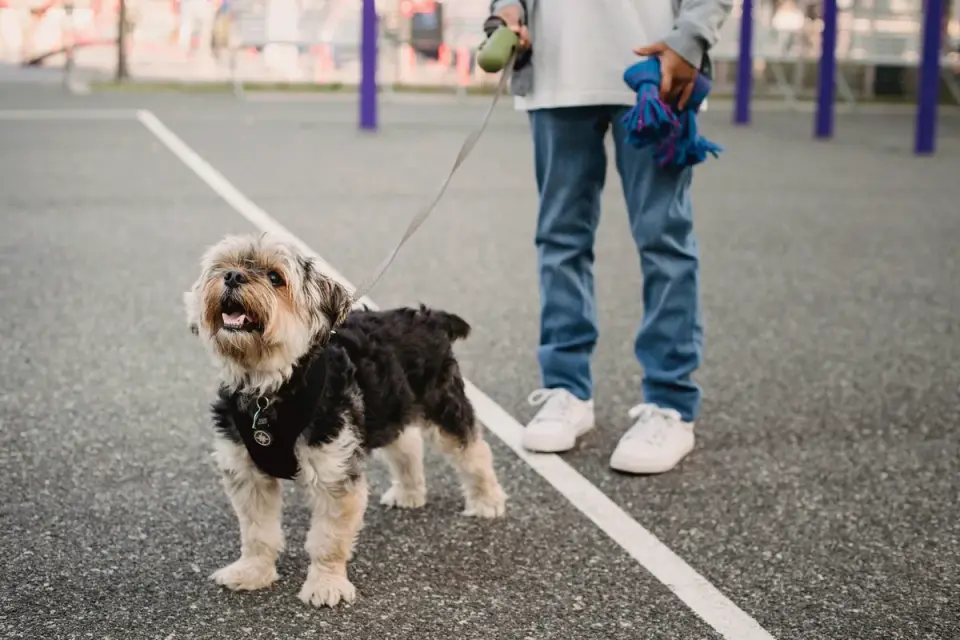
A loose-leash start is deliberately not a formal heel. At this stage the goal is just that walking next to a person doesn’t hurt and doesn’t mean constant tension. VCA Animal Hospitals’ overview of Puppy Behavior and Training – Socialization and Fear Prevention notes that positive, consistent training in this early period is associated with fewer behavior problems down the line than methods built around correction — which is as true for leash manners as it is for sit.
If you want the mechanics of the leash piece specifically, our guide on how to teach your dog to heel picks up exactly where this loose-leash start leaves off, once the puppy has a little more impulse control in place.
Where the order actually falls apart
The order breaks down in one predictable spot: owners skip straight to “down” or “stay” because those look impressive on video, before name recognition and sit are solid. Down and stay aren’t wrong to teach — they’re just cue six and seven, not one and two. Teaching them early isn’t dangerous, but it’s inefficient; you’re building on a foundation that isn’t set yet, and it usually means more repetition later to fix gaps that a slower start would have avoided.
The other place it falls apart is duration. A ten-week-old puppy has a genuinely short attention span, and cramming all five cues into one long session most days backfires — the puppy checks out, and every cue gets a little sloppier. Five-minute sessions, several times a day, consistently outperform one twenty-minute marathon.
I still think about a Labrador mix, about five months old by the time I saw him, whose owners had taught an impressive list of tricks — spin, high-five, play dead — but no reliable recall. He’d bolted through an open gate chasing a squirrel and spent forty-five minutes loose near a busy road before a neighbor cornered him in a driveway. Nothing happened to him, but it easily could have. We spent the next visit talking timelines, not tricks: what a real recall takes to build, why it has to be boring and repetitive before it’s ever tested somewhere exciting, and why the flashy cues can wait. That’s the conversation I have most often, and it’s the one I wish happened before week one instead of after a scare.
If you’re also working on other foundational cues, our pieces on how to teach a dog to shake and how to teach your dog to come when called go deeper on mechanics once these first five are in place. And if the household is still deciding how to structure sessions day to day, our puppy potty-training schedule pairs well with this cue order, since both run on the same short, frequent, low-distraction rhythm.
My verdict
Teach name recognition and sit first, come third and treat it as non-negotiable, then leave it and a loose-leash start to round out the first five. Skip the tricks until those are solid — they’re fun, but they’re not load-bearing. Keep sessions short, keep them frequent, and keep expectations realistic: a reliable indoor recall in a few weeks is a fair goal, off-leash reliability near real distractions is a much later one, and there’s no shortcut that changes that timeline.
Frequently asked questions
What's the very first thing I should teach a new puppy?
Name recognition. A puppy that reliably turns toward its name on sound alone makes every other cue easier to build, since you can't redirect or reward attention you don't have.
How long does it take to teach a puppy to come reliably?
A solid indoor recall on a long line is a reasonable two-to-three-week goal with short daily sessions. Off-leash reliability around real distractions, like traffic or other dogs, is a later and separate milestone.
Should I teach "down" and "stay" before "come"?
Not first. They're worth teaching, but they build best on a puppy that already responds to its name and holds a sit — treat them as cues six and seven, not one and two.
Sources
- Position Statement On Puppy Socialization — AVSAB
- 5 Simple Cues You Should Teach Your Puppy — American Kennel Club
- Puppy Behavior and Training - Socialization and Fear Prevention — VCA Animal Hospitals