Best Brush for a Short-Haired Dog
The best brush for a short-haired dog is almost never the one with the most reviews — it's the one matched to your dog's coat density.
On this page
Here’s the decision fork that trips up most short-haired-dog owners: they assume “short hair” means “low maintenance,” so they buy whatever brush is cheapest, and then wonder why their dog still sheds like it’s July in December. The truth is that coat length has almost nothing to do with which brush actually works — coat density does.
A Beagle, a Boxer, and a Labrador can all be described as “short-haired,” but their undercoats are wildly different, and that changes what tool actually pulls loose hair instead of just skating over the top of it.
What “short-haired” actually hides
Short hair is a length category, not a coat-structure category. Some short-coated breeds — Labradors, German Shepherds mixes with a short outer coat, Corgis — are still double-coated, carrying a dense, soft undercoat under a coarser topcoat. Others, like Boxers, Beagles, and Whippets, are single-coated with little to no undercoat at all. Double-coated breeds shed the heaviest because that undercoat blows out in clumps during seasonal transitions, according to the American Kennel Club. Dogs shed on a biological cycle, not a random schedule — hair grows through a growth phase, a transition phase, and a resting phase before it releases, and most dogs shed lightly year-round with heavier turnover twice a year in spring and fall.
That distinction matters because a tool built for a single, flat coat will underperform on a dense double coat, and vice versa — a heavy-duty deshedding tool on a truly single-coated dog can be more aggression than the coat needs.
Rubber curry brush vs. bristle brush: what each one is actually doing
These are the two workhorse tools for short coats, and they solve different problems.
A rubber curry brush has soft, flexible rubber teeth that you work in small circles against the direction of hair growth. The teeth loosen dead hair sitting near the skin and, in the process, massage the skin and stimulate circulation. A bristle brush does the opposite job: shorter, denser bristles that glide with the coat, sweeping away what the curry brush already loosened and smoothing the coat to a finish. Groomers generally use them in sequence rather than as substitutes — curry first to lift shed hair, bristle brush second to polish, a combination that tends to outperform either tool used alone, per grooming guidance summarized by Pride and Groom.
For dogs with a noticeable undercoat, a dedicated deshedding tool with a stainless steel edge that reaches through the topcoat can pull a meaningful amount of loose undercoat that a curry brush alone will miss, particularly during the spring and fall shed.
I’ve watched this play out more than once in exam rooms: a client comes in with a three-year-old Boxer, Otis, complaining that brushing “does nothing” — the owner had been using a long-toothed slicker brush meant for a fluffy coat, dragging it across skin with almost no hair to catch. We swapped her to a rubber curry brush and a short-bristle finishing brush, two minutes each, three times a week. Within about a month she told me the couch had noticeably less hair on it and Otis’s coat had a visible shine it hadn’t had before. That’s one dog’s routine, not a guarantee, but it’s a useful illustration of matching the tool to the coat rather than the marketing on the box.
Why brushing does more than manage hair on the floor
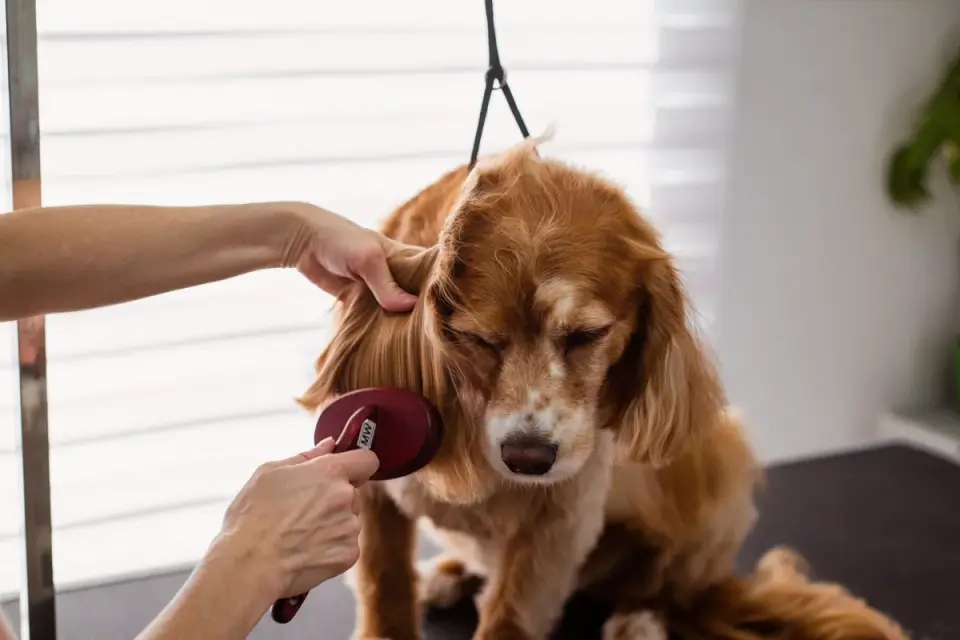
Brushing isn’t just cosmetic upkeep. Dogs have sebaceous glands that secrete sebum into the hair follicles and onto the skin — sebum keeps skin pliable, gives the coat its natural sheen, and has some antimicrobial properties. Regular brushing helps distribute that sebum evenly across the coat and skin, and it’s a genuinely useful, low-cost habit for supporting normal follicle function, per background summarized by the PetMassage Training and Research Institute. When sebaceous secretions build up unevenly and a follicle gets obstructed, that’s the kind of thing that can predispose a dog to a blocked gland or cyst — brushing isn’t a treatment for that, but it’s a reasonable, low-risk preventive habit worth keeping in the routine regardless of coat length.
Building the actual routine, not just buying the tool
For a short-haired dog, twice-weekly brushing is a reasonable baseline outside of shedding season, moving to closer to every other day during the heavier spring and fall transitions. Work in the direction that loosens hair first — against the grain with a curry brush — then finish with the grain using the bristle brush. If your dog also gets nail care and dental care on a rotating home schedule, it helps to batch it: a lot of owners I talk to find grooming sticks better as a habit when it’s paired with something already on the calendar, whether that’s how often to trim a dog’s nails or working tooth brushing into the same five-minute window.
If your dog’s coat blows out hard twice a year regardless of what tool you’re using, that’s a sign the undercoat is doing most of the shedding, and a proper deshedding tool earns its place in the rotation, not just a curry brush. And if brushing at home consistently reveals skin issues — flaking, odor, bumps you can’t explain — that’s worth a professional look rather than a longer brushing session; deciding when to hand grooming off to a professional is its own calculation, separate from which brush you own.
Where I land
A short single sentence, because this one doesn’t need hedging: for most short-haired dogs, the combination of a rubber curry brush and a short-bristle finishing brush, used twice weekly and stepped up during seasonal shedding, beats any single “best” brush sold alone. The counterargument I hear most is that a deshedding tool alone is simpler — one tool, one step — and for a heavily double-coated short-haired dog during peak shedding, I don’t disagree that it earns a spot in the drawer. But for daily maintenance and skin health between those heavy-shed weeks, the two-brush combination does more for the coat than the single aggressive tool, and it’s gentler on skin that doesn’t need that much lift every time.
Frequently asked questions
Do short-haired dogs need to be brushed if they don't have much visible hair?
Yes. Even minimal-shed short coats benefit from regular brushing because it distributes sebum, supports skin condition, and removes loose hair before it collects on furniture and clothing.
How often should I brush a short-haired dog?
Roughly twice a week as a baseline, increasing to every other day during spring and fall shedding seasons when double-coated dogs blow out their undercoat.
Is a rubber curry brush enough, or do I need a deshedding tool too?
For dogs with a real undercoat, a dedicated deshedding tool during seasonal shedding periods pulls more loose hair than a curry brush alone; for lighter single coats, curry plus bristle is usually sufficient year-round.
Sources
- Dog Shedding: When Dogs Shed Most and How to Manage It — American Kennel Club
- Dog brushes guide | Best dog brush — Pride and Groom
- Sebaceous Glands — PetMassage Training and Research Institute