Signs Your Dog Needs a Calming Supplement: A Vet-Reviewed Q&A
Medically reviewed by David Wilkes, DVM — For general education — not a substitute for veterinary care.
Restless pacing, excessive panting, and storm phobia are common signs your dog needs a calming supplement, vets say.

On this page
Scroll TikTok for more than five minutes and you’ll hit one: a “before” clip of a dog spinning, drooling, and shredding a doorframe, cut to an “after” clip of the same dog snoozing through a thunderstorm, calming chew in the bowl, hashtag proud. Calming supplements have become one of the fastest-growing corners of pet TikTok — which also means the category is full of “miracle chill pill” claims that don’t hold up to five minutes of research. So how do you actually tell whether your dog is dealing with something a calming supplement might reasonably help, versus something that needs a real behavior plan or a vet visit?
The Behavioral Signs Vets Actually Look For
Veterinary behaviorists don’t diagnose anxiety off one nervous moment — they look for a pattern. According to the veterinary behavior service at Tufts University’s Cummings School of Veterinary Medicine, anxious dogs commonly pant, pace, tremble, drool, withdraw from their owner, or hide, and some become “extra friendly,” repeatedly jumping up or licking a person’s face out of nervous energy rather than genuine excitement. Others go the opposite direction: barking or growling at a person or situation that wouldn’t normally bother them.
VCA Animal Hospitals’ veterinary team lists a similar cluster: pacing or shaking, whining or barking that escalates with the trigger, yawning, drooling, or lip-licking outside of mealtime, and panting with no recent exercise to explain it. Watch for “displacement behaviors” too — a dog that suddenly starts sniffing the floor, licking itself, or digging in a context where that behavior doesn’t otherwise make sense. It’s often a sign the dog is trying to self-soothe.
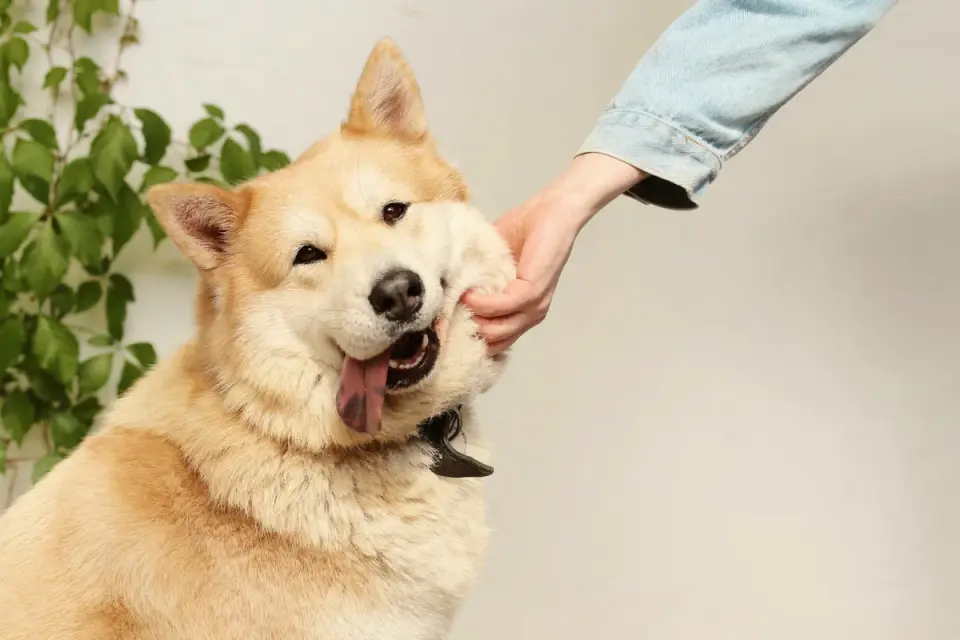
The Physical and Body-Language Signs
Behavior is only half the picture — body language often shows up first. Per VCA, look for dilated pupils with rapid blinking, ears pinned back, a tucked or rigid tail, and a dog that shifts its weight backward or cowers rather than approaching normally. Tufts’ behavior team adds a GI angle that’s easy to miss: chronic stress can show up as loose stool, vomiting, or a dog that suddenly refuses food it normally eats — worth a vet visit to rule out a medical cause before assuming it’s “just anxiety.”
Q&A: Supplement Question or Vet Question?
My dog only gets anxious during thunderstorms or fireworks — is that supplement territory? Often, yes. Situational, trigger-specific anxiety (storms, fireworks, car rides, vet visits) is exactly the profile most calming-ingredient studies have actually tested.
My dog is anxious pretty much all the time, not just around one trigger — same deal? Less so. Tufts’ behavior service treats generalized or chronic anxiety as a case for a full behavior-modification plan, environmental changes, and — for many dogs — prescription medication alongside any supplement, not instead of one.
How do I know if it’s “worth talking to a vet” versus “worth trying a chew first”? Both VCA and Tufts land in the same place: if the anxiety is frequent, triggered by more than one thing, or getting worse, loop in your vet before or alongside trying a supplement — partly to rule out pain or illness masquerading as “anxious” behavior, and partly because a veterinary behaviorist can build an actual treatment plan instead of you guessing.
What the Research Actually Says About Popular Calming Ingredients
This is where the hype usually outruns the evidence. Some ingredients have real trial data behind them; some really don’t. It’s worth knowing the difference before you buy.
Alpha-casozepine (a milk-protein-derived compound sold under the brand name Zylkene) has the most head-to-head data of the bunch. A 2007 trial in the Journal of Veterinary Behavior put it directly against selegiline, a prescription anti-anxiety medication for dogs, over 56 days — both reduced anxiety scores, with no statistically significant difference between the two. That’s a genuinely notable result for an over-the-counter ingredient, though it’s one trial against one comparator drug, not a mountain of replication.
L-theanine (studied under the brand name Anxitane) has its own dog-specific data: an open-label study in storm-sensitive, client-owned dogs published in the same journal in 2015 tracked owners through six separate storms and found a statistically significant drop in anxiety scores, with a reported 94% owner satisfaction rate. Worth noting: open-label means owners knew what they were giving — there was no placebo group — so some of that effect is almost certainly expectation, not the ingredient alone.
Ashwagandha is everywhere in the human wellness aisle, and the underlying human research is genuinely strong: a randomized, double-blind, placebo-controlled trial published in Clocks & Sleep found that 300 mg of ashwagandha root extract taken twice daily measurably improved sleep quality and lowered Hamilton Anxiety Scale scores in adults over eight weeks. That’s solid human data. What it is not, yet, is canine data — a comparable placebo-controlled dog trial doesn’t appear to exist, so any “ashwagandha calms dogs” claim is reasoning by analogy from human biology, not a proven canine effect.
The honest summary: a couple of calming ingredients have real, if modest, trial support in dogs specifically; others are borrowed from human research and haven’t been tested the same way in dogs. Both categories can be reasonable to try for situational anxiety — just don’t expect either to work like a sedative, and don’t expect a chew to fix anxiety that’s actually generalized or trauma-driven.
What to Check on the Label Before You Buy
Here’s the part most viral videos skip: pet supplements aren’t pre-approved by the FDA the way a prescription drug is, so quality control sits almost entirely with the manufacturer. The clearest independent signal to look for is the yellow seal from the National Animal Supplement Council (NASC) — member companies pass an independent third-party audit every two years, maintain a complaint and adverse-event reporting system, and submit to random product testing by outside labs. That’s not a guarantee the product will work for your specific dog, but it is a real, checkable floor for manufacturing quality and safety monitoring that an unvetted listing may not have.
Bottom Line
Occasional, trigger-specific nervousness around storms, fireworks, or car rides is the profile the calming-supplement research base actually supports, with alpha-casozepine and L-theanine carrying the most dog-specific trial data available today. Anxiety that’s constant, worsening, or paired with appetite or GI changes deserves a vet visit first — both to rule out a medical cause and to get an actual behavior plan. A supplement can be part of that plan. It’s rarely the whole plan.
Frequently asked questions
What are the earliest signs my dog needs a calming supplement?
Watch for repeated pacing, panting without exertion, trembling, hiding, or drooling around a specific trigger like storms or fireworks — veterinary behavior sources point to this cluster as the most consistent early marker of situational anxiety.
Do calming chews work as well as prescription anti-anxiety medication?
A 2007 dog trial found the ingredient alpha-casozepine performed comparably to the prescription drug selegiline over 56 days, but that's one head-to-head trial against one comparator drug, not a guarantee across every ingredient or every dog.
Can I give my dog a calming supplement every day, or only for specific triggers?
Most of the strongest dog-specific trial data (L-theanine, alpha-casozepine) comes from situational use around specific triggers like storms. Talk to your vet before committing to daily long-term use, especially alongside any other medication.
How do I know if a calming supplement brand is trustworthy?
Look for the NASC Quality Seal, which requires an independent third-party audit, adverse-event reporting, and random product testing. Pet supplements otherwise aren't pre-approved by the FDA the way drugs are.
When should I see a vet instead of just trying a supplement?
If the anxiety is frequent, triggered by more than one thing, getting worse, or paired with appetite or GI changes, loop in your vet first to rule out a medical cause and build an actual treatment plan.
Sources
- Anxiety in Dogs — Cummings School of Veterinary Medicine at Tufts University
- Signs Your Dog is Stressed and How to Relieve It — VCA Animal Hospitals
- An open-label prospective study of the use of l-theanine (Anxitane) in storm-sensitive client-owned dogs — Journal of Veterinary Behavior, 10(4):324-331 (Pike, Horwitz & Lobprise, 2015)
- Effects of alpha-casozepine (Zylkene) versus selegiline hydrochloride (Selgian, Anipryl) on anxiety disorders in dogs — Journal of Veterinary Behavior, 2(5):175-183 (Beata et al., 2007)
- Comparative Evaluation of Ashwagandha (Withania somnifera) Root Extract and Melatonin for Improving Sleep Quality in Adults: A Prospective, Randomized, Double-Blind, Placebo-Controlled Study — Clocks & Sleep (DOI:10.3390/clockssleep8020015)
- NASC Quality Seal — National Animal Supplement Council